
My name is Stephan Löcke, and I’m a registered Psychotherapist for Cognitive Behavioral Therapy (Psychologischer Psychotherapeut für Verhaltenstherapie) in Cologne.
„There is hope, even when your brain tells you there isn’t.”
– John Green, Turtles All the Way Down
Detailliertere Informationen auf Deutsch zur Praxis für Psychotherapie in Köln finden Sie auf der Startseite.
Field of expertise
In my private practice, I specialize in a broad spectrum of mental-health issues, including, among others: anxiety disorders, mood disorders, personality disorders, substance abuse, and adult attention-deficit/hyperactivity disorder (ADHD).
I draw on a variety of therapeutic techniques, including Acceptance and Commitment Therapy (ACT), Schema Therapy, and Mindfulness-based Cognitive Therapy. Mindfulness is an important part within my sessions. I have been practicing meditation (Zazen) since 2018.
Education and psychotherapy training
- License to practice as a Psychotherapist (Approbation District Government of Cologne) since 2020
- Psychotherapy Training Programme for Cognitive Behavioural Therapy at AVT Köln
- Master of Science in Clinical Psychology at Radboud University, Master’s thesis „How does mindfulness-based cognitive therapy work? Possible mechanisms of change“
- B.Sc. in Clinical Psychology at Ghent University
- B.A. in Communication Sciences at Radboud University
- Psychotherapist at Schlosspark-Klinik for substance abuse in Bergisch Gladbach
- Psychotherapist training in practice Prof. Dr. Dr. Pukrop und practice Dipl. Psychol. Firat-Deveci
- Psychologist at the Institute for Psychosomatic Medicine and Psychotherapy at University Clinic Düsseldorf
- Psychologist at Schön Clinic for psychosomatic Medicine in Bad Arolsen (Depression, ADHS, Tinnitus)
Fee structure and Payment Options
I welcome clients with private insurance and self-paying clients. Insurance reimbursement depends on your individual contract with the insurer. For public health insurance, pre-approval from the insurer is required.
The fee for an initial 50-minute consultation is 135,88€. All fees are based on the fee structure for psychotherapists (Gebührenordnung für Psychotherapeuten).
| Billing code | Service | Amount |
|---|---|---|
| 812a | Initial consultation, 50 min | 134,06 € |
| 855a | Diagnostic tests | 75,75 |
| 860 | Biographical anamnesis | 123,34 € |
| 808 | Therapy initiation | 53,62 € |
| 812a, 801a | Therapy session, 50 min | 167,58 € |
Location and Accessibility
Hansaring 45-47
50670 Köln (Neustadt-Nord)
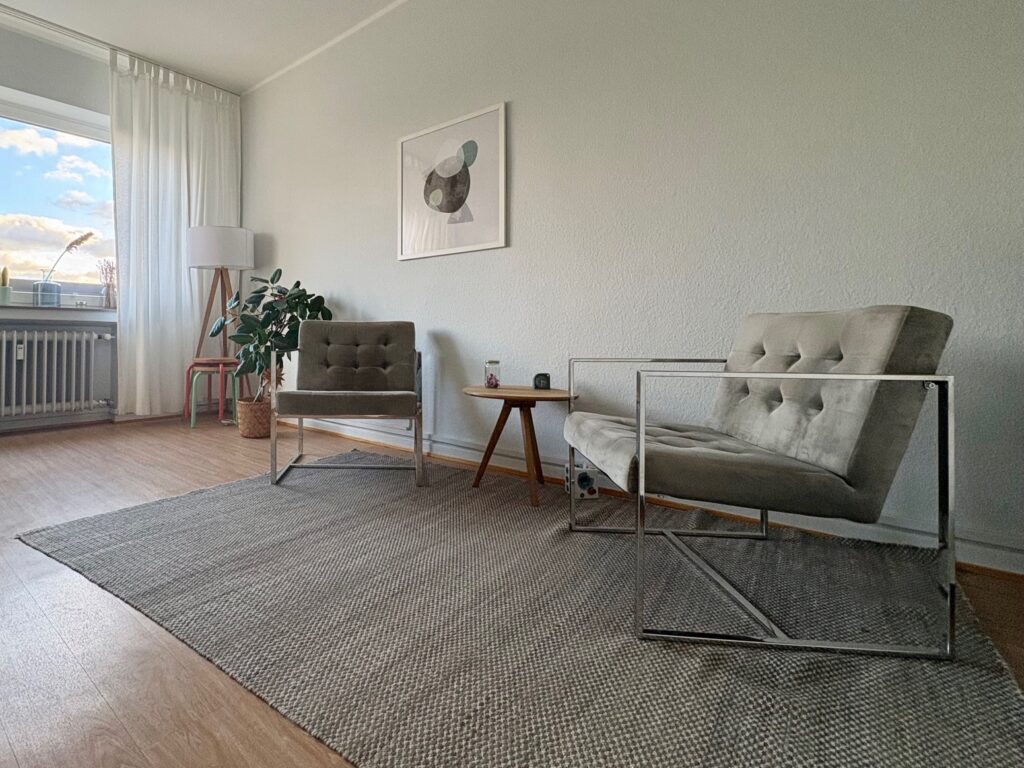
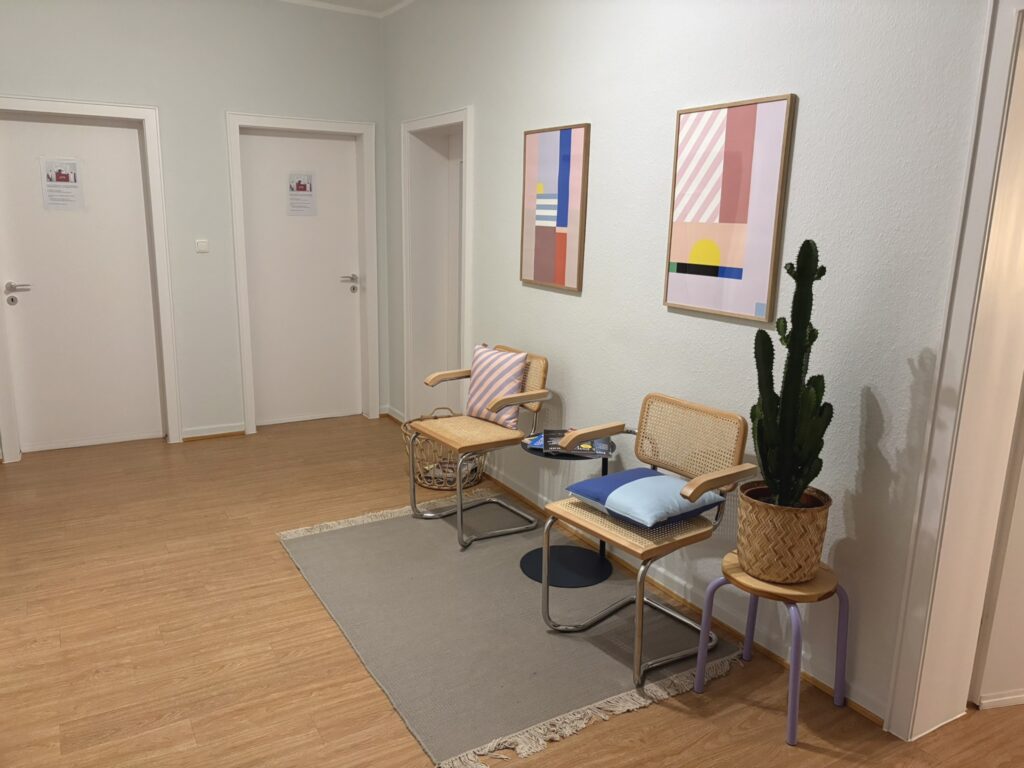
The practice is located in Cologne’s city centre and is situated on the 3rd floor of the building.
Arrival by public transport
The practice is within walking distance of the Hansaring S-Bahn station.
- Stop Hansaring (tram lines 12 and 15 as well as suburban train lines S6, S11, S12, S13, S19)
- Stop Christophstr. / Mediapark (tram lines 12 and 15)
Paid parking is available in front of the practice.
Please feel free to contact me by email or phone to schedule an appointment. Sessions are available in person or via video therapy.

Self-help resources
For additional self-help resources between sessions or while waiting for therapy, I recommend exploring the Centre for Clinical Interventions website. This platform offers evidence-based self-help modules covering a wide range of topics, including depression, anxiety, procrastination, and self-compassion. The materials include practical workbooks and exercises you can complete at your own pace.
Frequently Asked Questions
In general, private health insurance / Beihilfe covers the costs of outpatient psychotherapy. For further information, check with your private health insurance provider.
Of course, it is also possible to access psychotherapy treatment as a self-payer. The costs are based on the Fee Schedule for Psychotherapists (GOP).
In my private practice in Cologne, billing with statutory health insurance is only possible after prior approval by the health insurance company. Further information regarding an application for cost reimbursement.
The approval process typically takes 6 to 8 weeks, though timelines can vary depending on your specific insurance provider. Approval rates differ significantly between insurance companies – some are more accommodating than others when it comes to cost reimbursement applications. If approved, coverage for up to 60 therapy sessions may be available, depending on the severity of your condition and the treatment plan.
I am happy to assist you throughout this process by providing the required documentation and guidance.
Usually within a few days. Please feel free to book an appointment online via Doctolib or send me an email.
In addition to outpatient psychotherapy on-site in Cologne, I also offer online psychotherapy. I use a secure, certified video service provider (Videosprechstunde by WebPrax), which ensures the privacy and confidentiality of sessions.
No, you do not need a referral from a GP (Hausarzt) to start psychotherapy in Germany. You can contact a psychotherapist directly and book an appointment.
Cognitive behavioral therapy is one of the most effective treatment methods for depression. It helps those affected to recognize and change negative thought patterns and core beliefs that contribute to maintaining the depression. Through behavioral activation, patients learn to gradually re-engage in pleasant activities and break out of the vicious cycle of withdrawal and low mood. The therapy also teaches concrete coping strategies for dealing with difficult emotions such as loneliness, guilt, or sadness.
Yes, cognitive behavioral therapy has also proven successful in treating chronic depression. I like to work with mindfulness-based approaches, such as MBCT (Mindfulness-Based Cognitive Therapy) by Segal & Teasdale. This combines cognitive behavioral therapy with mindfulness meditations based on Jon Kabat-Zinn’s work. Mindfulness-based approaches help break out of the rumination cycle: those affected learn to perceive negative thoughts and feelings without judging or fighting them. Ultimately, regular mindfulness practice creates an observing distance from depressive thought patterns („I am not my thoughts“). Another focus is recognizing early warning signs, which helps identify relapses more quickly.
With panic attacks, those affected first learn to correctly interpret physical symptoms (e.g., rapid heartbeat, dizziness) and to question catastrophic thoughts that arise. Breathing techniques and relaxation methods can help better manage acute anxiety states.
A central component is exposure treatment: patients confront the feared bodily sensations in a controlled manner to experience that they are harmless. This gradually reduces the fear of fear. Exposure treatment is very effective for anxiety disorders.
Cognitive behavioral therapy (CBT) is considered the first-line treatment for obsessive-compulsive disorders. The central method is exposure with response prevention: those affected expose themselves to anxiety-triggering situations but consciously do not perform the compulsive ritual. This allows them to experience that the feared catastrophe does not occur. Additionally, dysfunctional beliefs are addressed. Many patients experience a significant reduction in obsessive-compulsive symptoms.
A Psychologischer Psychotherapeut (psychological psychotherapist) like myself has studied clinical psychology and completed specialized postgraduate training in psychotherapy. We provide CBT and psychological interventions but do not prescribe medication.
A psychiatrist (Psychiater) is a medical doctor who specializes in mental health. Psychiatrists can prescribe medication. They may also provide therapy, though many primarily manage medication.
A psychologist (Psychologe) has a psychology degree but may not have completed the additional training required to provide psychotherapy.
Only licensed psychotherapists (Psychologischer Psychotherapeut) or medical psychotherapists (Ärztlicher Psychotherapeut) can bill insurance for psychotherapy.